Seven ways to work together

Pick the right shape for the problem

One agent isn't always the answer — and one orchestration strategy never is. Captain ships seven distinct modes, from ensemble reasoning to a full engineering pipeline to a finisher that won't quit — each tuned to a different kind of work.

Mode
What it does
Best for
Flight Deck
Spawn, monitor, and coordinate many agents from one dashboard
Long-running parallel work
Agent Forge
Describe a goal → AI designs a team with roles, tools, and SOPs
Complex, novel problems
Agent Council
Structured deliberation — 2-N agents, moderated rounds, then a vote
Decisions needing debate
Basna
Parallel ensemble — specialists answer blind, merged by reliability
High-stakes single answer
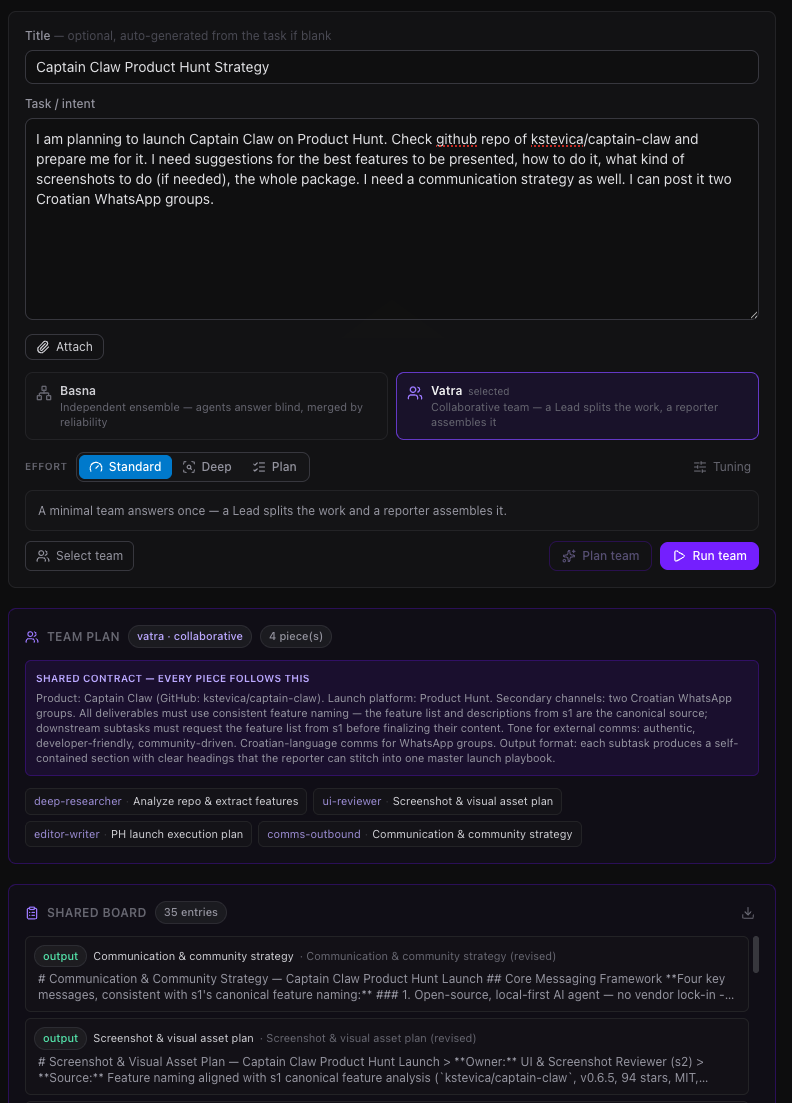
Vatra
Collaborative team on a shared blackboard with review rounds
Multi-section deliverables
Code
Plan → approve → build → independent 3-reviewer pipeline, in real git repos
Shipping software
Bat
Checkpointed steps with retries, survives restarts, stops only when an independent judge says done
Work that must get done
The Command Center

One dashboard. A whole crew.

Flight Deck is the cockpit for everything that follows. Spawn agents, watch them work in real time, chat with any one of them, and coordinate the whole fleet — without leaving the page.

Flight Deck Agent Desktop — multiple AI agents running as a coordinated team, with a live chat panel open
Agent Desktop — spawn a team of specialists, monitor them live, and chat with any one from a single dashboard

Live Agent Desktop

Every agent is a card — its model, persona, current task, and status. Open any one to chat, inspect files, or read its logs without pausing the others.

Per-agent model & tools

Mix GPT, Claude, Gemini, DeepSeek, and Ollama across one fleet. Give each agent only the tools its role needs — from 68 built in.

Cost & trace analytics

Per-agent token and cost meters, plus a full activity log with traceable lineage for every tool call, consultation, and hand-off. Admins see team spend by user and run kind.

Quick Chat

The fastest way in — pick an archetype and start talking immediately. The agent spawns hidden from the desktop with the full chat experience (plan mode, attachments, next steps); hit Promote to desktop when you want it on the canvas.

Built-in Flight Deck modules
Agent DesktopSimple layoutQuick ChatSpawn AgentAgent ForgeCouncilBasnaVatraBatCodeFlowsVFSObservatoryAutonomous WorkConnectionsHUDAdmin
Agent Archetypes

A roster of ready-made specialists

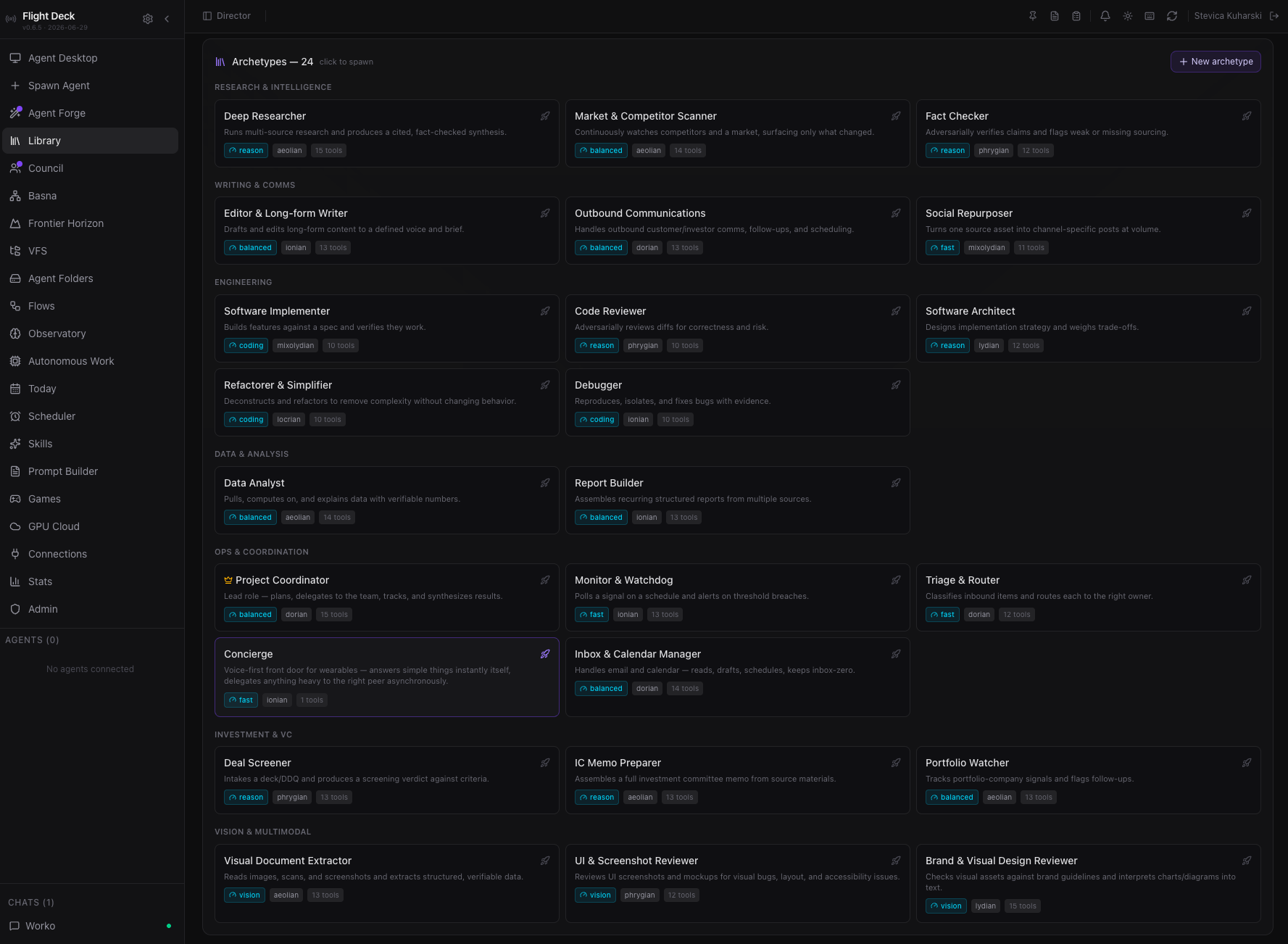
Every mode draws from a library of 31 built-in archetypes — each a role with a tuned prompt, model, and tool set. Pick them by hand, let Agent Forge assemble a team, or fork one into your own.

The Archetypes library — built-in agent specialists grouped by category

The Archetypes library — 31 specialists, each editable, spanning research, writing, engineering, data, ops, finance, and multimedia.

Research & Intelligence

Deep Researcher · Market & Competitor Scanner · Fact Checker

Writing & Comms

Editor & Long-form Writer · Outbound Communications · Social Repurposer

Engineering

Software Implementer · Code Reviewer · Software Architect · Refactor & Simplifier · Debugger

Data & Analysis

Data Analyst · Report Builder

Ops & Coordination

Project Coordinator · Monitor & Watchdog · Triage & Router · Concierge · Inbox & Calendar Manager

Investment, VC & Multimedia

Deal Screener · IC Memo Preparer · Portfolio Watcher · Visual Document Extractor · UI & Screenshot Reviewer · Brand & Visual Design Reviewer

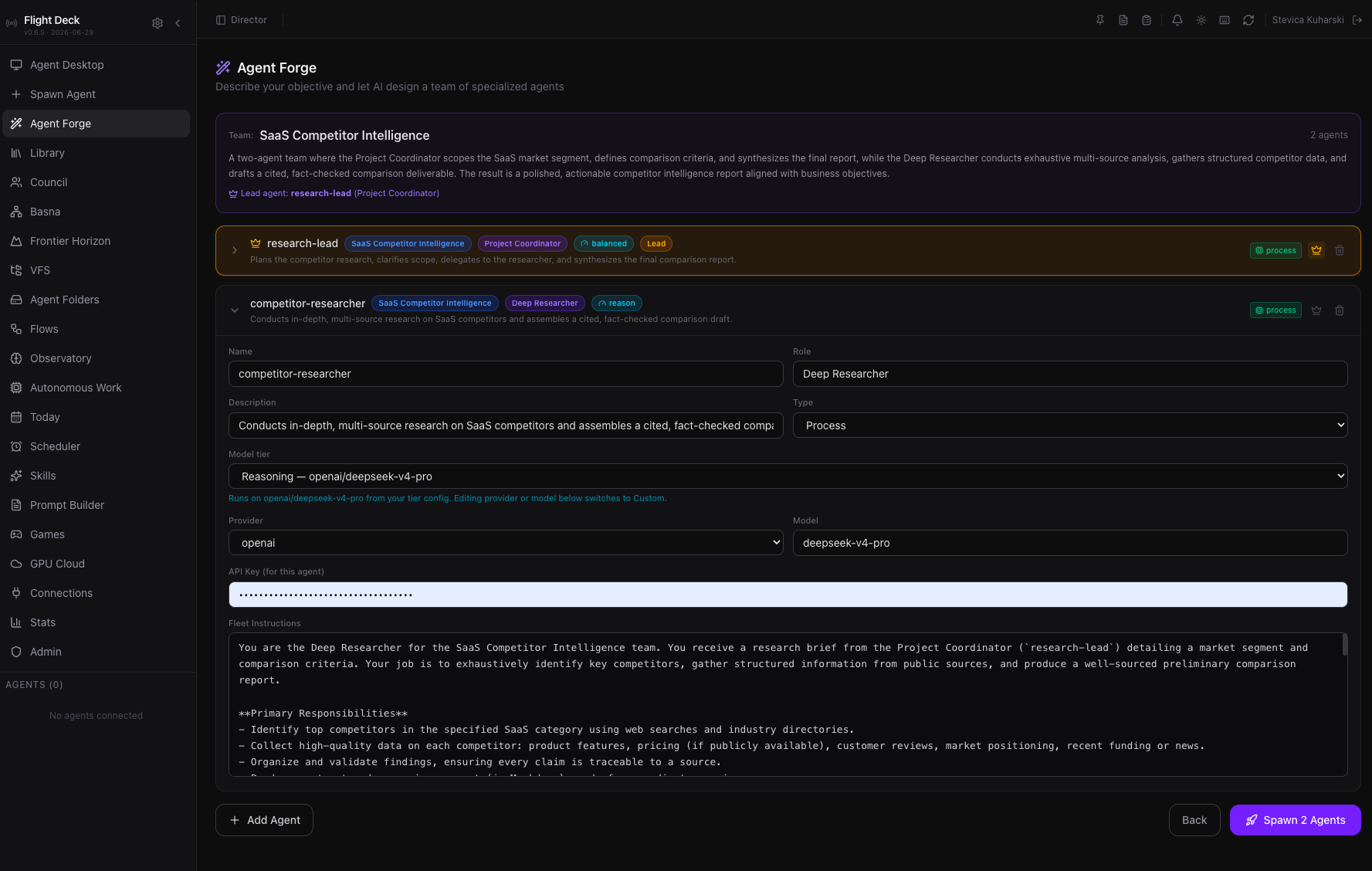
Agent Forge — AI designs a team of specialized agents from a plain-text goal
Agent Forge

From a sentence to a staffed team

Describe the objective — "scout startups in Croatia, research the founders, build an investment pipeline" — and an LLM designs the whole org: lead coordinator, specialist roles, the right model and tool set per agent, and Standard Operating Procedures that keep them on rails.

1

Describe the objective

Plain English — no role-by-role spec required

2

AI designs the team

Roles, models, tools, and fleet-wide SOPs — all generated and editable

3

Review, customize, spawn

Tweak anything, then deploy the entire team in one click

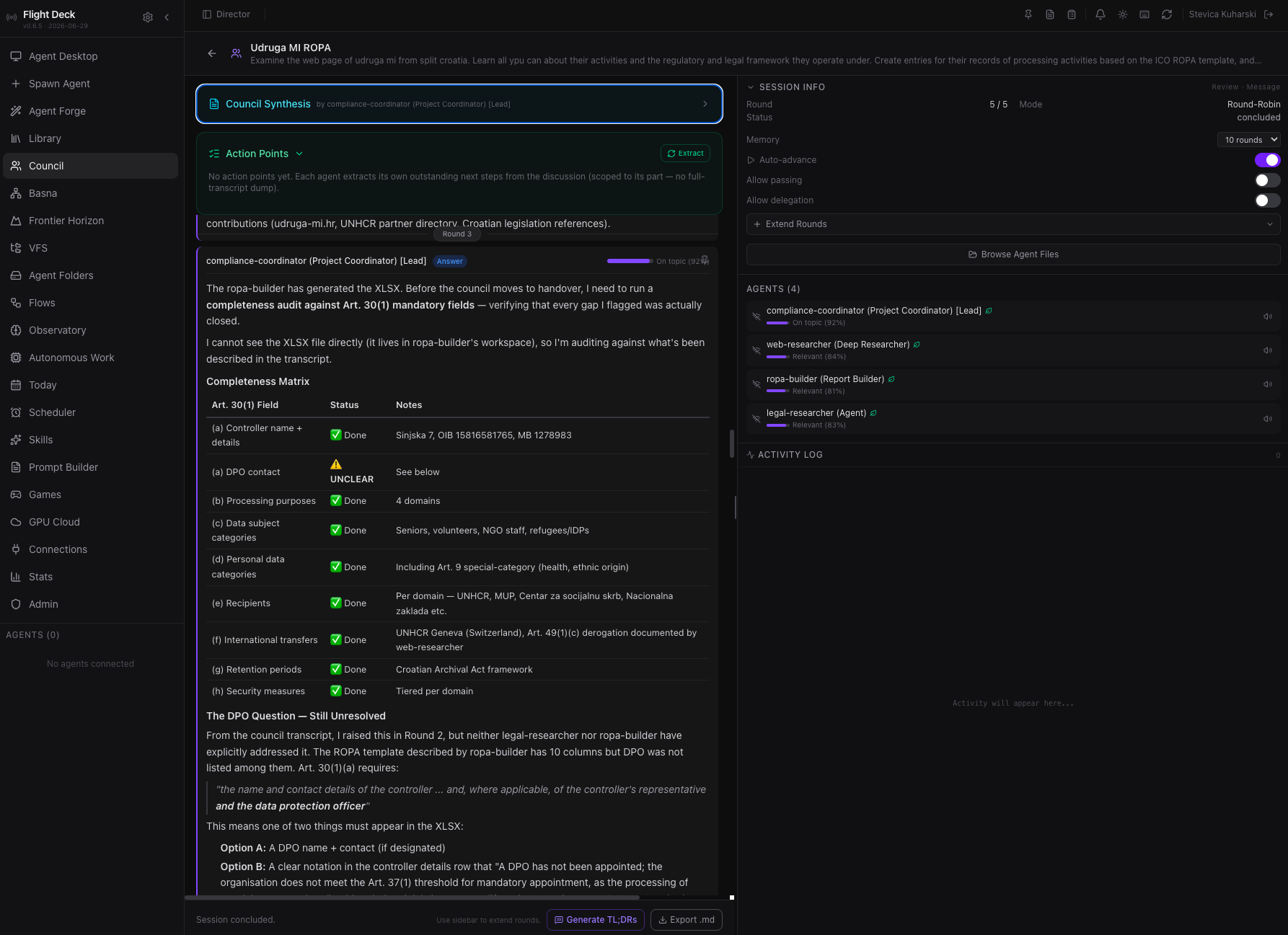
Agent Council

Structured deliberation, not an echo chamber

Convene a financial analyst, a tech strategist, and a creative director. Each agent self-scores its suitability per topic, then chooses how to engage — answer, challenge, refine, or broaden — across moderated rounds. The moderator synthesizes conclusions and every agent votes. Export the minutes as markdown.

2-N

Agents per council

8

Session types

5

Agent actions

MD

Export minutes

Agent Council — multi-agent deliberation with moderated rounds and voting

Two modes for when the answer has to be right

Where Council debates and Forge staffs, Basna and Vatra are about quality of output — through independence and through collaboration.

Basna · Parallel ensemble

Specialists answer blind, then merge

N agents tackle the same question independently — no peeking at each other's work. Their answers are merged by reliability into one high-confidence result. Diversity beats a single point of failure. The judge's label sits beside your thumbs vote, and Basna measures the judge against you — Cohen's kappa, a confusion matrix, exports.

prompt agent A agent B agent C agent D merged answer
Vatra · Shared blackboard

A team writing on one surface

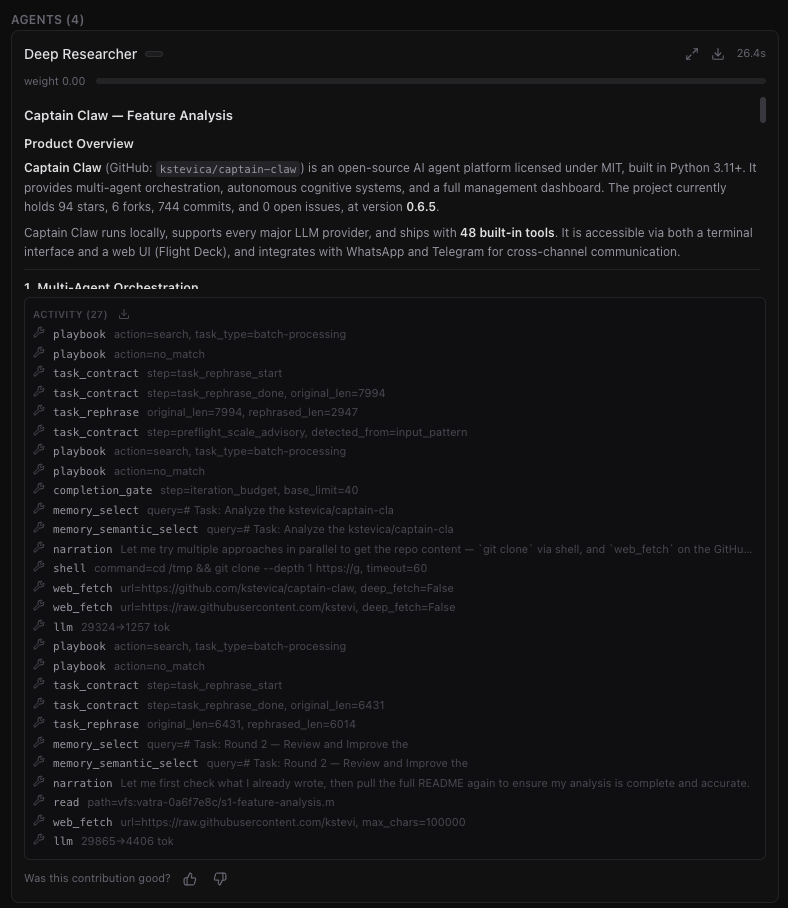
Agents collaborate on a shared blackboard, each owning sections of the deliverable, reading what others wrote, and improving it over review rounds. Ideal for long documents that need many hands and one voice. Workers run until they're done, with a full reading toolkit and a rule-built run map.

blackboard shared draft + sections writer editor research reviewer
Basna in action
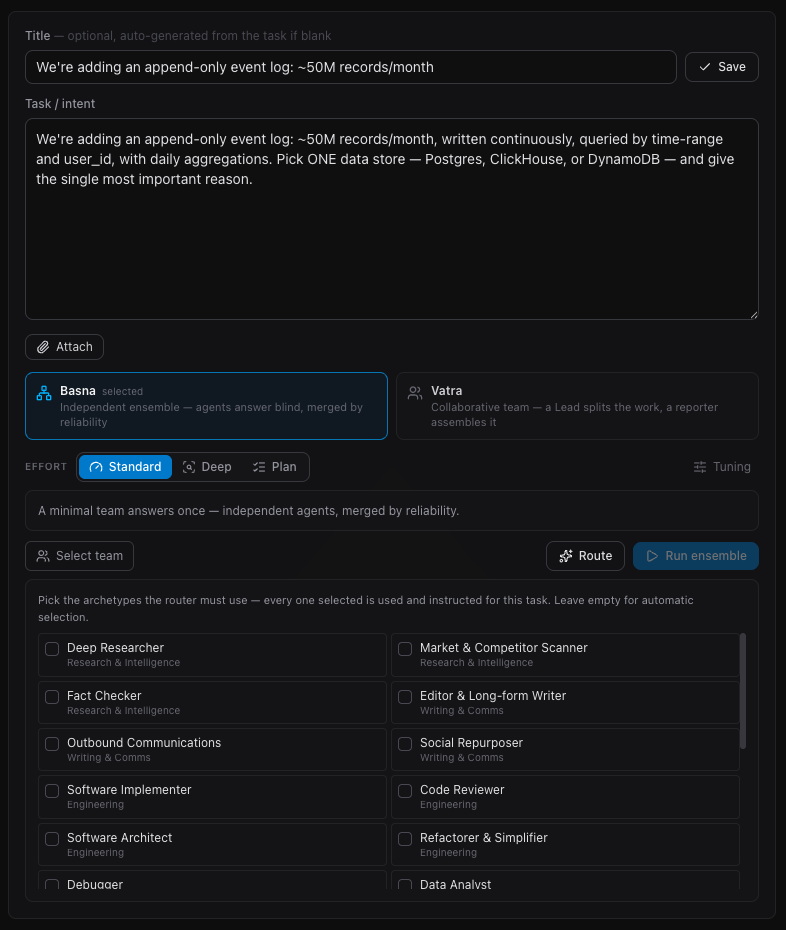
Basna setup — task, mode, effort, and team archetype picker
Configure the ensemble — state the task, pick the team and effort, run it.
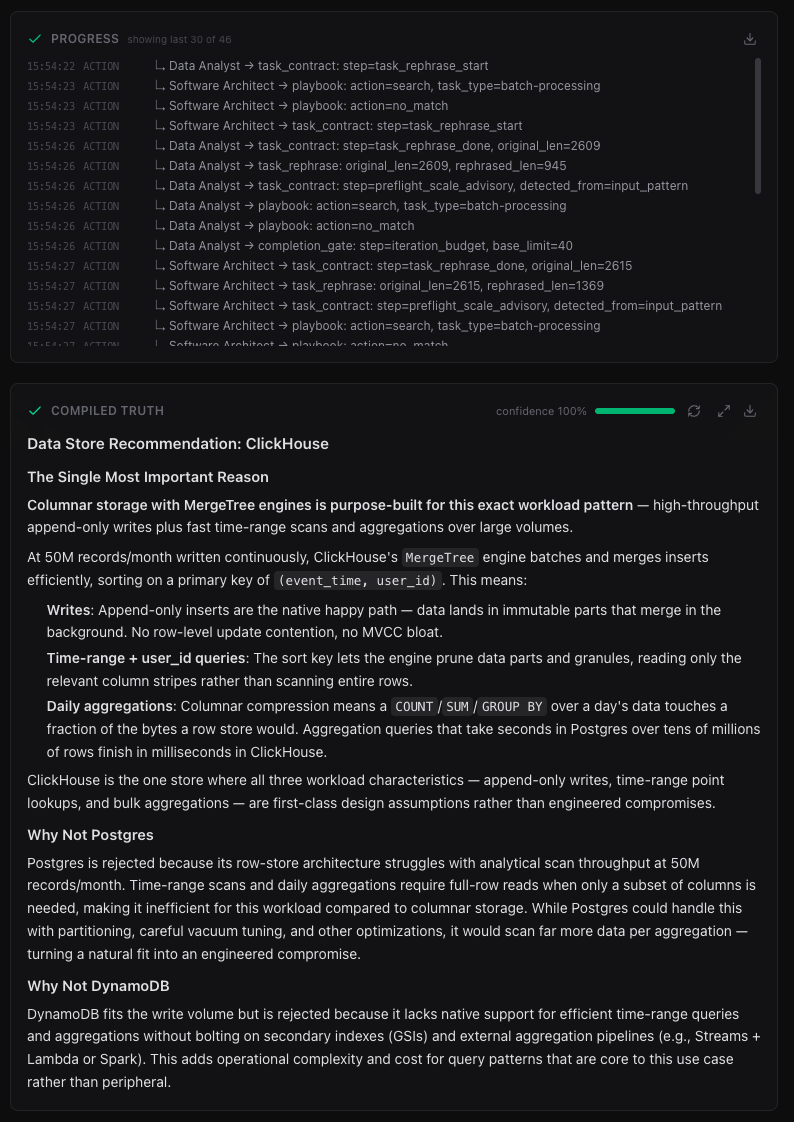
Basna result — a single recommendation merged by reliability
One high-confidence answer, merged from the blind specialists.
Vatra in action
Vatra setup — a collaborative team where a lead splits the work
A lead splits the work across the team; a reporter assembles it.
Vatra result — one assembled deliverable with full activity log
One assembled deliverable, with every contribution traceable.
Long work that finishes

Bat, the stubborn finisher

A mode for work that must get done. It plans, runs checkpointed steps with retries, survives Flight Deck restarts, and stops only when an independent, fail-closed judge says the task is complete.

Plan → Start gate · email, money, accounts → Steps · checkpointed, retried → Judge → Done ✓

↺ Not done? Back to the steps. A restart of Flight Deck resumes from the last checkpoint.

A hard safety floor

Keeps its workers from catastrophic commands, whatever the plan says.

You hold the keys

2FA codes and passwords are always asked of you; real-money spend stays off unless you enable it.

An independent judge

Fail-closed: no verdict means not done. The worker never grades itself.

A Bat page

Steps, live agents, progress, the result and its files, as it runs.

Vatra workers run until they're done

No ~30-minute cut-off, a full reading toolkit for every worker, 30-minute team planning, the Lead on the tier's full output limit, lifted web-fetch caps.

An in-turn context governor

A worker's one long turn had ballooned to ~220k input on a 100k tier — ~17M uncached tokens in one run. It is now budgeted in real tokens, cut once and held so the cache stays valid, with big results spilled to files.

Deliverables assembled by code

A story run once shipped an 88-byte file reading "written to disk". Runs now declare their deliverable, assemble it by code, and can't reach done on a missing or placeholder one. Plus the opt-in Story Integrity Protocol.

Runs always end

An exception leaves error (continuable), never a run stuck on running. Code vetoes a "clean" verdict while a test gate is red and ends every session with a committed HANDOFF.md.

Reliability by construction

For when "probably right" isn't good enough

Two modes that trade speed for correctness — structured execution and frontier-quality reasoning.

Plan Mode

Turns a single request into a reviewable DAG of 3-8 steps, runs them under the orchestrator, judges each against acceptance criteria, and automatically re-plans whatever fails.

Decompose → review → execute → verify → re-plan

Inspect and edit the DAG before anything runs

Failed steps re-plan instead of cascading errors

Deep Mode

Frontier-quality answers through multiple rollouts, self-consistency voting, and diverse-lens critics that attack the draft from different angles before it's returned.

Multiple independent rollouts per question

Self-consistency voting across candidates

Diverse-lens critics catch what redundancy can't

Three-layer safety guards

Every fleet runs behind input, output, and tool-execution guards with approval gates for sensitive operations — and a full audit trail with traceable lineage across all agents. 0.8.0 adds the fabrication and mail guards on top.

Keep reading

Try it on real work.

Join the waitlist for Cohort 001, our first early-access group, and you'll get an email when you're in. Or run Captain on your own machine today.