Forge agents New in 0.8.5

Say what you need. Get a team.

You know what the job is, but not which agents would do it. Say it in your own words and attach your files. Captain plans a small team of standing agents, you approve it, and it recommends what should run on a schedule and what software is worth building.

In the kiosk: New agent → Forge agents. Close the dialog at any point: it carries on, and the bell brings it back.
deck.example.com · Forge agents
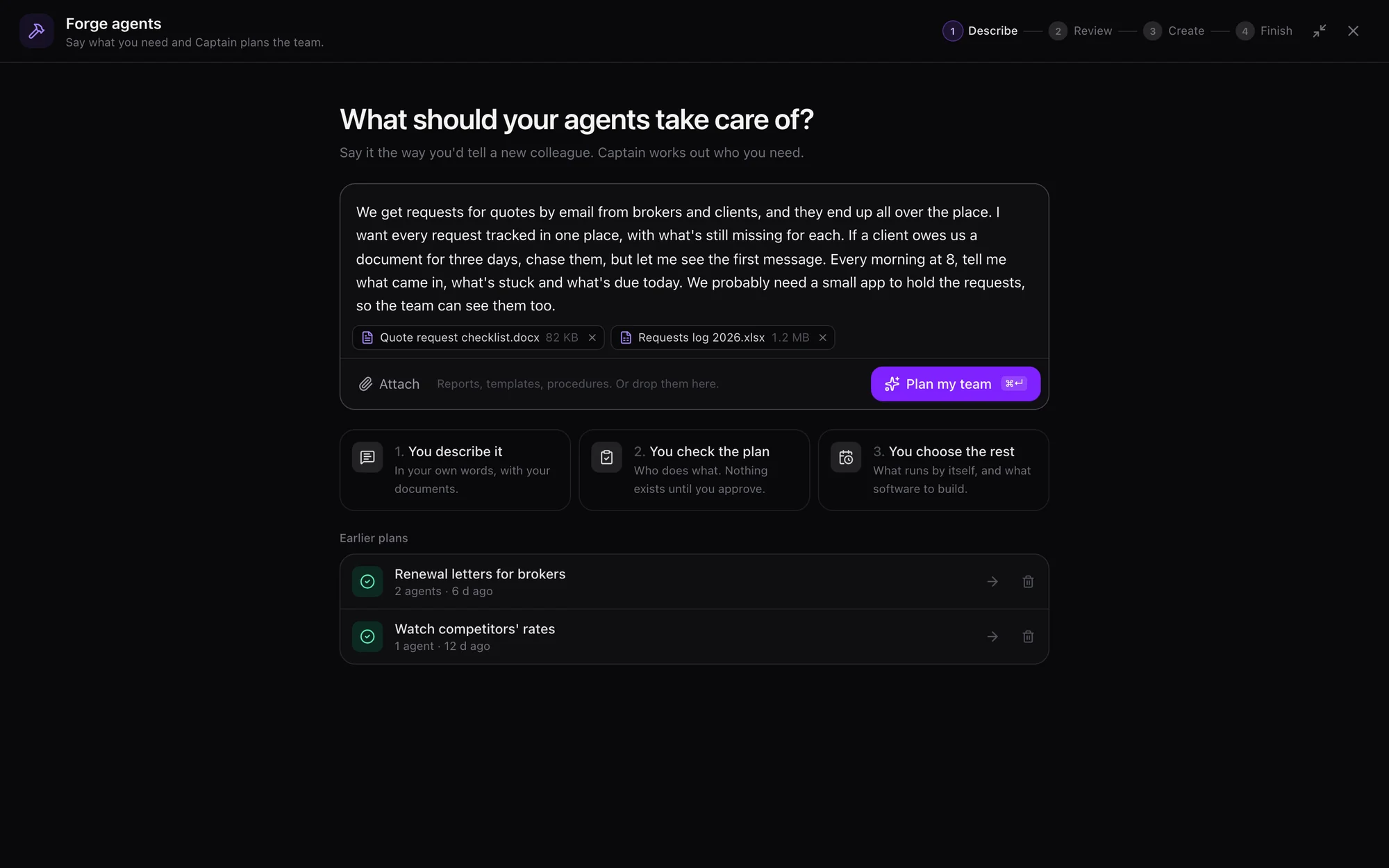
Forge agents, Describe: What should your agents take care of?, a request about tracking quote requests and chasing missing documents, two files attached, and Plan my team

Four steps. Nothing exists until you approve.

  1. 1

    Describe

    Your request in your own words, the way you'd tell a new colleague, and up to 10 files of 25 MB each.

  2. 2

    Review

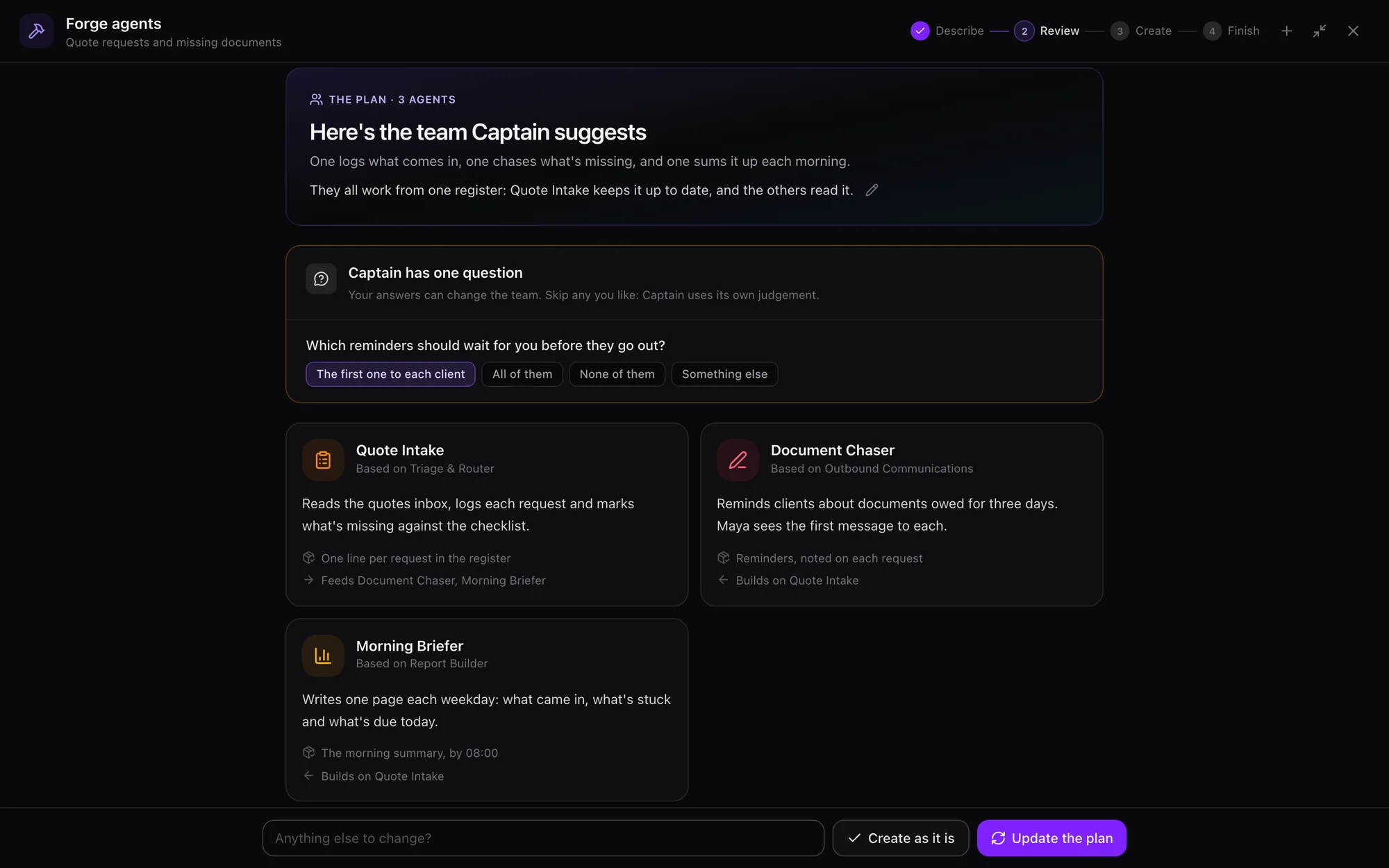
    An agent opens your files, and the planner picks the fewest standing agents that cover the request, writes each one's job and may ask you questions. Rename, rewrite or leave out anything.

  3. 3

    Create

    Each agent gets its way of working, its job and its teammates. The team shares a folder and one set of data tables, and they can ask each other.

  4. 4

    Finish

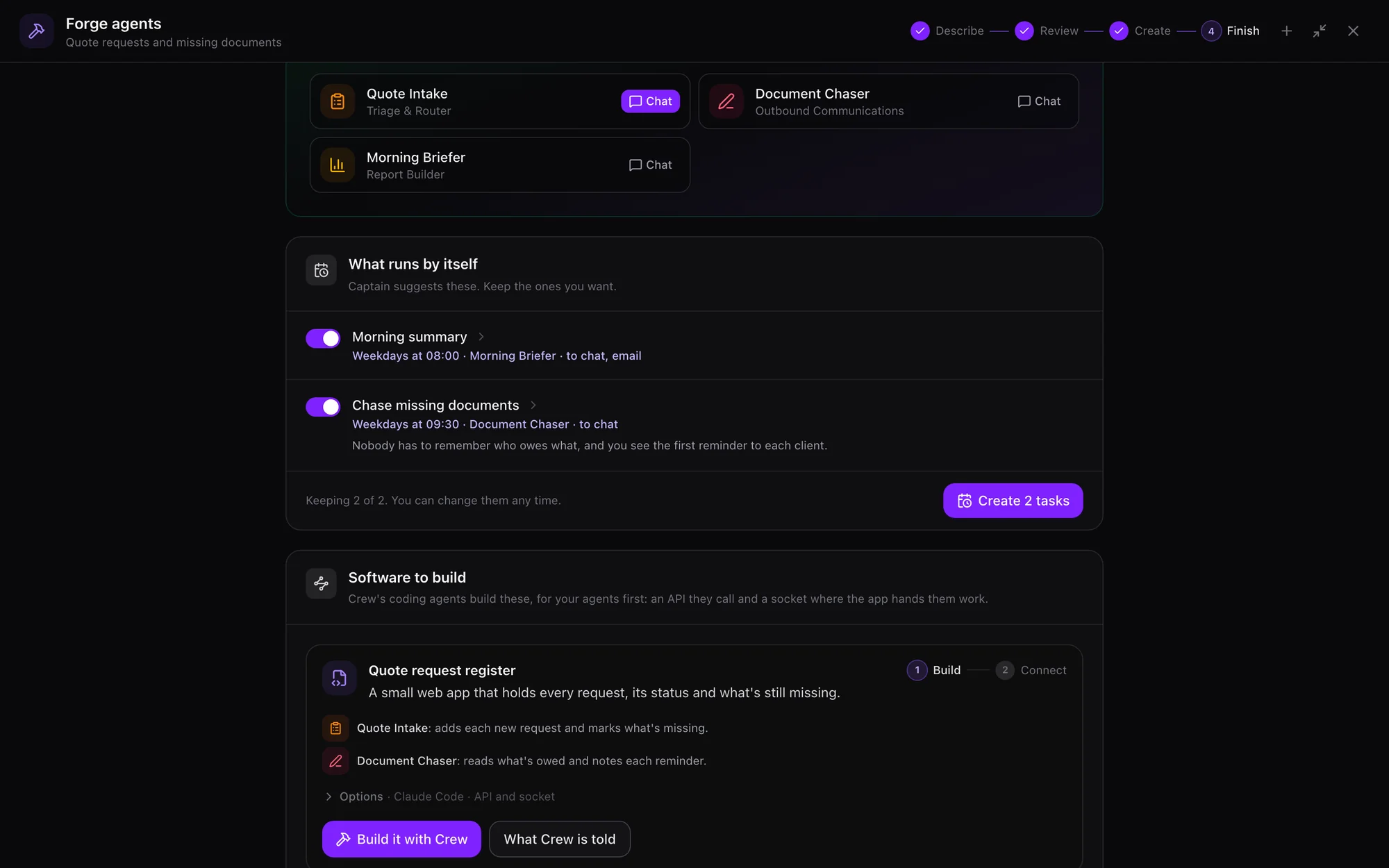
    Captain recommends what should run by itself and what software is worth building, with why and how you'd use each. Only what you keep gets made.

deck.example.com · Forge agents
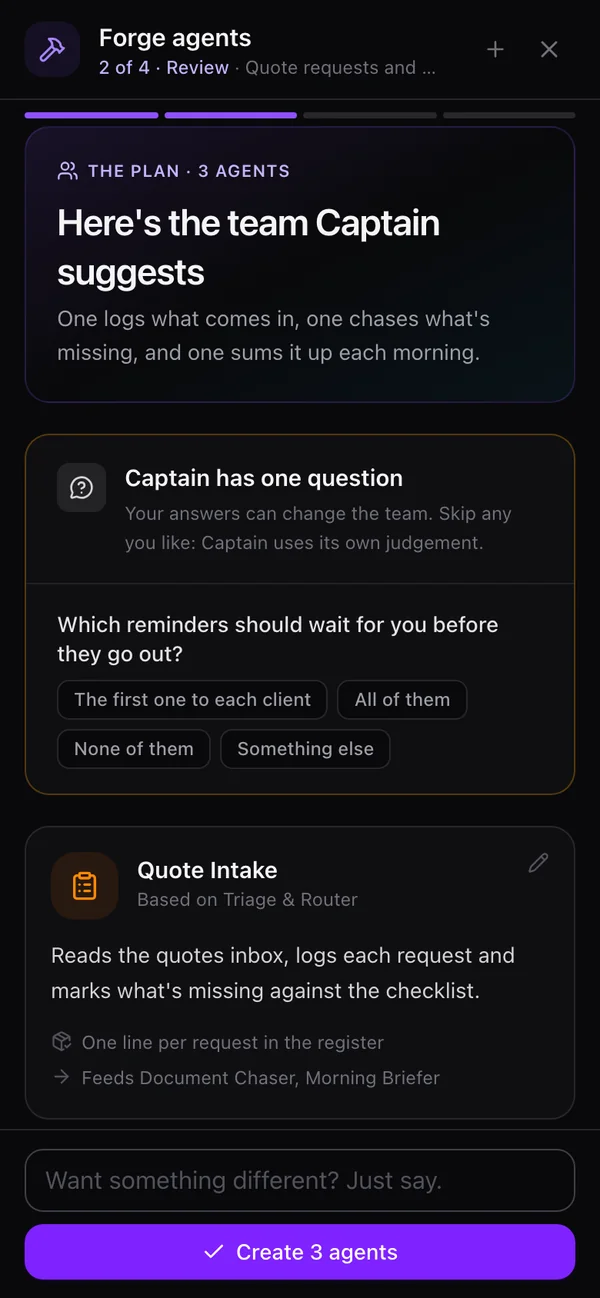
Forge agents, Review: Here's the team Captain suggests, one question with an answer picked, and three proposed agents with their jobs: Quote Intake, Document Chaser and Morning Briefer

The real interface, with made-up people and data. A plan never exceeds the room your agent limit leaves.

Finish Schedules and software

The team gets its own tools.

  • What runs by itself becomes scheduled tasks, listed with any others, delivering to chat, email or Telegram.
  • Software to build goes to Crew as ordinary tasks, so its approval and limits apply, and you land the work there.
  • Every app is built to one contract. An HTTP API with a bearer key and a manifest that says what it offers, a WebSocket that speaks the agent link protocol, or both. No model writes that part.
  • Connect your agents ties it together. Give the running app's address and key. Captain reads the manifest, registers the API on the agents you choose and links them to its socket. The key is never in the plan or their instructions.
deck.example.com · Forge agents
Forge agents, Finish: three new agents with Chat buttons, two suggested scheduled tasks with switches, and a quote request register to build with Crew

An agent knows its job with no one in its chat.

A standing agent mostly runs on a schedule or for a linked system, with nobody watching. So Captain tells it its job before each scheduled turn, and before a linked system's first turn after it starts. A link also follows its agent when a restart moves it to another port.

What it doesn't do yet: it has run end to end with a stand-in model, CLI and app, but a real model's plan and a real worker building to the contract have yet to be tried together. A team's tables aren't listed in the Data library. A non-admin can't host a runnable app, so Connect then needs an admin or another host. Agents come from the archetype catalog.

Forge agents docs · Agent Forge, in the full layout, designs a team around a goal and spawns it in one click

Forge agents' review on a phone

Keep reading

Try it on real work.

Join the waitlist for Cohort 001, our first early-access group, and you'll get an email when you're in. Or run Captain on your own machine today.